
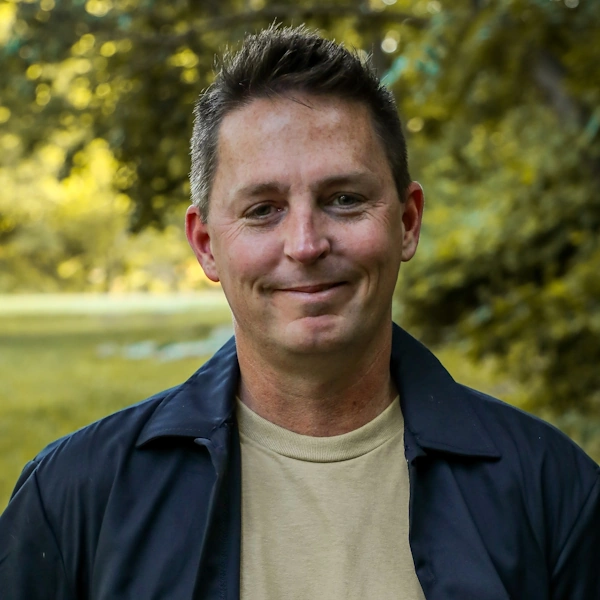
About James Bunch
How I got here
I'm a software engineer in Kansas City, Missouri, and I've been building software for more than 25 years. Here's the short version of how I got here, including the parts that didn't go to plan.
From hardware to software
In college I had a few part-time jobs doing IT work, and I wrote a few small databases in Microsoft Access along the way.
I've often used placement agencies to find work. When I first told them I wanted to move from IT, mostly hardware support, into software, I got some resistance. They could sell me on my IT experience. All of my software experience was from school or teaching myself.
A long commute that wasn't
Then I got an internship building a dynamic user interface for a division that would later be sold and become MessageXpress. (More on that in Deciding without all the facts.)
I also took a placement at Kwikset, writing an HR system for them. I thought I was signing up for a job with a long commute. It turned out they expected me to do the work from home and only come in for meetings and to demo the program.
After college, I took my first full-time job with a big corporate employer.
Three jobs, one decision
When that division was sold, the new owners were told that if they wanted work done, they should call me. There was infrastructure work to separate it from the parent company, and they'd been impressed with what I'd built.
Right around then, Kwikset called about another project. I'd taken it on with the understanding that I'd do it off hours. Then MessageXpress called too, and I couldn't juggle all three.
So I had a big decision: stick with corporate America, or go out on my own. My full-time job made it a little easier. They were having layoffs, and I volunteered. For better or worse, I went out on my own. That was 1999, and I started Bunch Consulting. MessageXpress had a big need to update their system for the Y2K bug, so I had plenty to do.
The best education I could have had
Most of my early career bounced between contract jobs through an agency and past clients getting hold of me for more work. The good news was that I had a reputation that brought me work. The "bad" news was that the software I wrote was stable enough that it was often years between engagements.
It may have been the best learning experience possible. On my own projects, I had to answer every question that came up myself. When I was placed somewhere, it was usually a larger company, so I got to see what everyone else was doing, and the pros and cons of other ways to build software.
Along the way, I moved to Kansas in 2008, and to Kansas City, Missouri in 2016.
Software KC, and a partnership that didn't work
In 2017, I tried to bring on a partner. We couldn't figure out the legal side of bringing him into Bunch Consulting, so we took a name I was already doing business under, Software KC, turned it into an LLC, and dissolved Bunch Consulting.
The partnership didn't work out. That left me with about 80 hours a week of work and no support, and that did not go well. After a couple of years of being overwhelmed, I went back to 9-to-5 style contracts.
I did that until the pandemic. When my contract wasn't renewed, because nobody knew what was coming, I took a full-time job and worked on that team for three years. Eventually I decided it wasn't the best use of what I do well, and in 2023 I left the 9-to-5 world and recommitted to Software KC full time. The company never shut down. I just came back to it.
Perfect timing, or terrible timing
Since early in my career, I'd been working on a tool for generating code quickly. When I took another look at it in 2023, I realized I was three to six months from finishing it.
The timing was either catastrophic or perfect, and I'm not sure which yet. About the time I was finishing it, AI came along.
Right now we use our own deterministic system to write the code that makes things secure, stable and scalable, and we use AI mostly for user interface work. It's hard to predict what AI will be able to do in the near future. But our system gives us a fallback. If AI gets very expensive or unreliable, the worst case is that we lean on the deterministic system we already use as our foundation.
Software KC today
Today at Software KC, we build custom software and software-as-a-service, modernize older systems, and connect tools that need to work together. We also partner with other companies in the Kansas City area, so we can have a bigger impact than we ever could alone.
Outside work
I dance. Lindy Hop and East Coast Swing are my two best, but I've done ballroom, salsa and pretty much anything else. I bowl with my family, and I golf.
I'm also interested in neuroscience and the difference between reality and perception. That's where What's real and what we perceive came from.